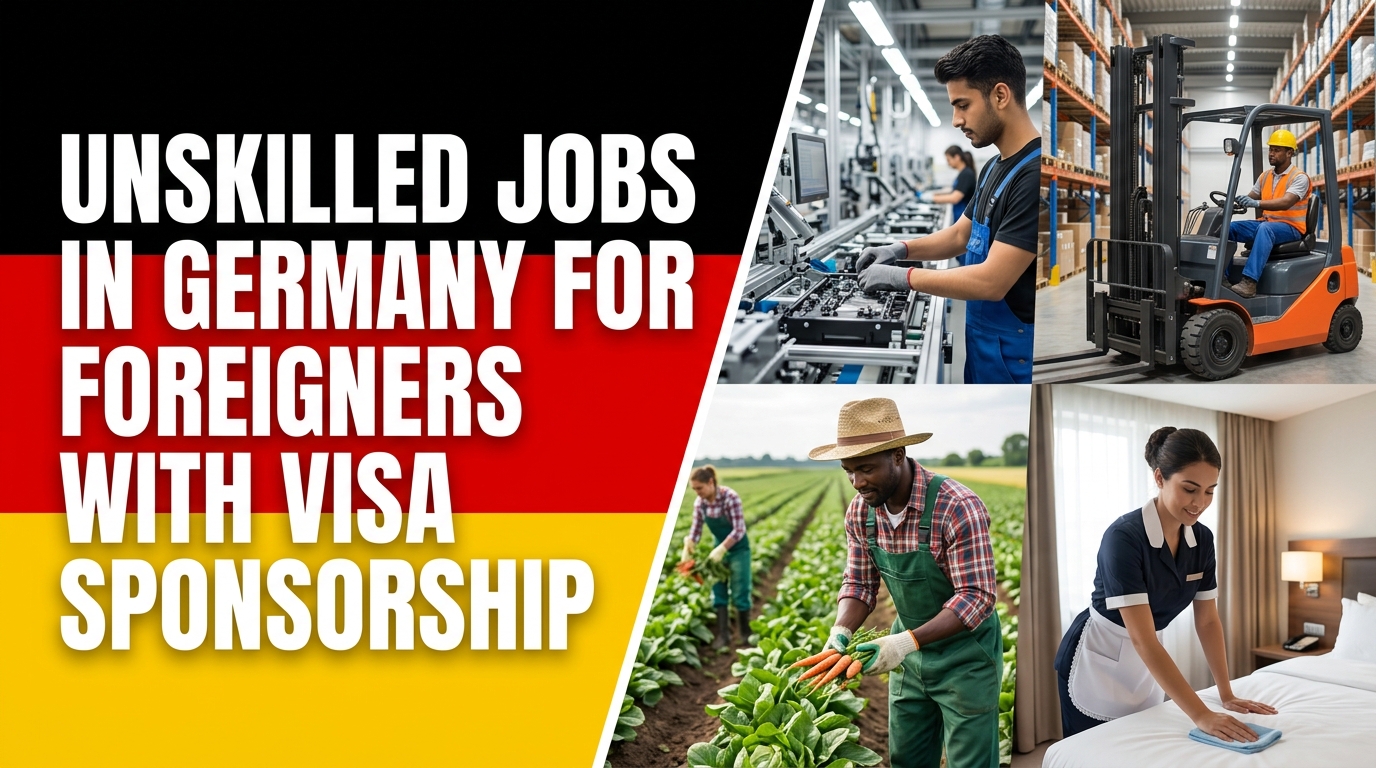
Unskilled jobs in Germany with visa sponsorship are among the most accessible employment opportunities available to foreign nationals in 2025. Germany’s Federal Employment Agency reported over 1.44 million vacant positions across the country, with critical shortages in hospitality, agriculture, warehousing, and retail driving employers to recruit internationally. Workers from Nigeria, India, Kenya, the Philippines, and beyond are securing legal employment through Germany work visas for unskilled workers — earning between €9 and €15 per hour with full access to Germany’s social benefits system, including health insurance and paid leave.
The Germany Opportunity Card, introduced under the Skilled Immigration Act, has opened a new entry route for non-EU nationals. Combined with traditional temporary work permits and job seeker visas, the pathways into the German labor market are more accessible than they have been in years.
This guide covers every stage of the process: which roles are being sponsored, what each visa requires, what employers pay by sector, the true cost of living in Germany, and a step-by-step application process to go from application to arrival.
Why Germany Is Actively Recruiting Foreign Workers for Unskilled Roles in 2025
Germany’s labor shortage is structural, not cyclical. The country’s population is aging faster than its workforce can replace retiring workers. According to the Institut für Arbeitsmarkt- und Berufsforschung (IAB), Germany will need 288,000 net new immigrants annually through 2035 just to maintain its current workforce size. Entry-level and unskilled roles are among the hardest to fill domestically.
The sectors with the most acute shortages — hospitality, agriculture, logistics, and cleaning services — are precisely the sectors where foreign workers without formal qualifications are most employable. These are not backup options. They are priority hiring areas for major German employers.
Germany’s minimum wage rose to €12.41 per hour in 2024, according to the Federal Ministry of Labour and Social Affairs, with sector-specific collective agreements pushing wages higher in logistics and hospitality. For workers relocating from countries with significantly lower wage floors, the financial case is clear.
Beyond wages, Germany’s employment law mandates benefits that many countries do not require at entry level — statutory health insurance, 24 days of paid annual leave minimum, sick pay from day one, and pension contributions that begin immediately. These are not perks negotiated with individual employers. They are legal requirements that apply to every worker, including visa-sponsored foreign nationals.
Germany’s Federal Employment Agency job vacancy data tracks live shortages across all sectors and is updated monthly — a useful resource for identifying which roles are hiring fastest in your target region.
Which Foreign Nationals Qualify for Unskilled Work in Germany
Non-EU nationals from any country can apply for unskilled work in Germany provided they meet the visa requirements for their chosen pathway. Germany does not maintain a restricted country list for unskilled work visas. Nationals from Nigeria, Ghana, India, the Philippines, Kenya, and dozens of other countries are actively represented in Germany’s foreign worker population across entry-level sectors.
EU nationals have the right to work in Germany without a visa. This guide focuses on non-EU nationals who require employer sponsorship or a visa to enter and work legally.
Most In-Demand Unskilled Jobs in Germany With Visa Sponsorship — Roles and Pay Rates
Germany’s labor shortages concentrate in five sectors for unskilled and semi-skilled foreign workers. Each sector has different wage floors, language requirements, and visa pathways.
Hospitality — Hotel and Restaurant Staff
Germany’s tourism and food service industry employs hundreds of thousands of workers in roles that require no formal qualifications. Kitchen helpers, dishwashers, housekeeping staff, and waitstaff are in constant demand across Berlin, Munich, Hamburg, and resort regions.
- Kitchen Helper: €9–€13 per hour
- Housekeeper: €8–€12 per hour
- Waitstaff: €9–€12 per hour
Basic German at A1–B1 level is expected for most hospitality roles due to daily customer and team interaction. Major employers including AccorHotels, McDonald’s, and Burger King sponsor work visas for reliable candidates and often provide on-site training.
Agriculture — Seasonal Farm Workers
Seasonal agricultural work is one of the fastest visa pathways into Germany for unskilled foreign workers. Fruit picking, harvesting, and general farm labor roles run from April through October, with high demand for workers during peak seasons.
- Farm Laborer: €9–€13 per hour
- Fruit Picker: €8–€12 per hour
Agricultural visas are typically temporary and season-specific. Employers in this sector frequently handle the visa paperwork directly, making it one of the most employer-supported entry routes for first-time applicants. Platforms like Seasonalworkvisa.com list active agricultural placements with confirmed visa sponsorship.
Warehousing and Logistics
E-commerce growth has made warehouse and logistics roles one of Germany’s fastest-growing employment categories. Amazon, DHL, and Metro AG operate large distribution networks across Germany and recruit internationally for warehouse operatives, packagers, and delivery support roles.
- Warehouse Worker: €10–€14 per hour
- Delivery Driver: €10–€15 per hour
German language proficiency is often optional in large warehouse environments where operations are managed through systems rather than verbal instruction. This makes logistics one of the most accessible sectors for workers with limited German.
Retail — Supermarket and Store Staff
Germany’s major supermarket chains — Aldi, Lidl, and REWE — operate thousands of locations nationwide and regularly hire cashiers, stock clerks, and store assistants. These roles require basic customer interaction skills and, for most positions, at least A1–B1 German.
- Cashier: €9–€13 per hour
- Stock Clerk: €9–€12 per hour
Retail roles with Aldi and Lidl are notable for their structured working hours and consistent pay — both chains operate under collective wage agreements that exceed the national minimum wage floor.
Cleaning and Facility Services
Cleaning roles in hotels, office complexes, schools, and public facilities are among the most consistently available entry-level positions in Germany. ISS Facility Services is one of the largest employers in this sector and actively recruits foreign workers.
- Cleaner: €8–€12 per hour
- Janitor: €8–€12 per hour
Physical fitness and attention to detail are the primary requirements. Most employers provide equipment and training. German at A1 level is typically sufficient for cleaning roles.
Job portals including Arbeitnow, Indeed Germany, StepStone, and Jooble list thousands of visa-sponsored unskilled positions with filters for English-speaking roles and employer-sponsored applications.
Germany Visa Options for Unskilled Workers: Costs, Requirements, and Timelines
Unskilled jobs in Germany do not qualify for the EU Blue Card, which requires a university degree and a minimum salary of €58,400 per year. The three primary visa pathways for unskilled non-EU workers are the temporary work visa, the Opportunity Card, and the job seeker visa.
Temporary Work Visa for Unskilled Workers
This is the standard pathway for non-EU nationals who have already secured a job offer from a German employer. The visa authorizes legal work in Germany for the duration of the employment contract, typically up to 12 months with renewal options.
Requirements:
- Formal job offer from a registered German employer
- Proof of financial stability — a blocked account holding a minimum of €11,904 (equivalent to 12 months of the monthly needs-based amount) is the standard requirement
- Valid international health insurance covering the visa application period
- Valid passport with at least six months remaining validity
- Police clearance certificate
Opening a blocked account through providers like Expatrio or Fintiba takes three to five business days and costs approximately €100–€150 in setup fees. The funds remain in the account and are released monthly after arrival in Germany.
Germany Opportunity Card (Chancenkarte)
The Opportunity Card is a points-based visa introduced under Germany’s Skilled Immigration Act that allows non-EU nationals to enter Germany for up to 12 months to search for work — including unskilled and semi-skilled roles.
Requirements:
- Minimum two years of recognized vocational training or a university degree
- German language proficiency at A1 level, or English at B2 level
- Financial stability — approximately €12,000 in a blocked account or equivalent proof
- No prior criminal record
While in Germany on the Opportunity Card, holders can work part-time up to 20 hours per week and take trial employment arrangements. Once a full-time job offer is secured, the card converts to a standard work visa without requiring the holder to leave Germany. This is one of the most flexible entry routes available.
Germany’s official Make it in Germany portal provides the current Opportunity Card eligibility checklist and application guide, updated as immigration policy changes.
Job Seeker Visa
The job seeker visa allows non-EU nationals to enter Germany for six months to find employment. It requires proof of qualifications, financial stability, and health insurance. Upon securing a job offer, the visa converts to a work permit.
| Visa Type | Best For | Duration | Leads to Residence Permit | Work Allowed |
|---|---|---|---|---|
| Temporary Work Visa | Applicants with a job offer | Up to 12 months | Yes | Full-time |
| Opportunity Card | Qualified job seekers | 12 months | Yes, after job offer | Part-time (20 hrs) |
| Job Seeker Visa | Active job hunters | 6 months | Yes, after job offer | No (trial only) |
Application Process for All Visa Types:
- Secure a job offer or confirm eligibility for the Opportunity Card
- Open a blocked account (Expatrio or Fintiba) and obtain health insurance
- Gather documents: passport, job contract or qualification proof, health insurance certificate, police clearance, blocked account confirmation
- Submit the application at the German Embassy or Consulate in your home country
- Processing takes two to four months — apply early
- Upon arrival, register with the Foreigners’ Registration Office (Ausländerbehörde) within 14 days to receive your residence permit
Unskilled Worker Salaries vs. Cost of Living in Germany — What You Actually Take Home
Understanding net income after taxes and social contributions is more useful than gross hourly rates. Germany deducts income tax, health insurance contributions, pension contributions, and unemployment insurance from every paycheck — typically between 30% and 40% of gross salary for entry-level workers.
Gross Monthly Salary by Role (Based on 173 Hours/Month)
| Role | Hourly Rate (€) | Gross Monthly (€) | Est. Net Monthly (€) |
|---|---|---|---|
| Kitchen Helper | 9–13 | 1,557–2,249 | 1,090–1,574 |
| Farm Laborer | 8–12 | 1,384–2,076 | 969–1,453 |
| Warehouse Worker | 10–14 | 1,730–2,422 | 1,211–1,695 |
| Cashier | 9–13 | 1,557–2,249 | 1,090–1,574 |
| Cleaner | 8–12 | 1,384–2,076 | 969–1,453 |
Monthly Living Costs in Germany (2025 Estimates)
- Rent: €800–€1,500 for a one-bedroom apartment in Berlin, Munich, or Hamburg. Smaller cities like Leipzig or Dresden run €500–€900.
- Food: €250–€400 per month for a single person cooking at home
- Public transport: €60–€100 per month (monthly pass in most major cities)
- Health insurance: €100–€200, though employer-sponsored workers have contributions split with their employer
- Miscellaneous (utilities, phone, entertainment): €200–€300
Total estimated monthly costs: €1,410–€2,500. Workers in lower-cost cities with employer-subsidized housing — common in agriculture and some hospitality roles — can reduce living costs significantly and save a meaningful portion of monthly income.
Top German Employers That Sponsor Visas for Unskilled Workers
These companies have established international recruitment processes and active visa sponsorship programs for entry-level roles:
- Amazon Germany operates major fulfillment centers in Bad Hersfeld, Koblenz, Leipzig, and Rheinberg. It recruits warehouse operatives and logistics staff internationally, offering health insurance, paid training, and structured shift patterns.
- DHL hires across warehousing, parcel sorting, and delivery support roles throughout Germany. DHL’s size and international presence make its HR infrastructure well-equipped to handle foreign worker visa applications.
- Aldi and Lidl operate collective wage agreements that set pay above the national minimum. Both chains hire cashiers and stock workers at scale and have recruited internationally during peak shortage periods.
- McDonald’s and Burger King franchise networks across Germany hire kitchen staff and servers with basic language requirements. Franchise operators in tourist-heavy cities are among the most active sponsors for hospitality visas.
- TTA Personal GmbH is a German recruitment agency specializing in hospitality and healthcare placements for international candidates. It manages visa paperwork on behalf of both candidates and employers, making it a practical first contact for applicants without a direct employer connection.
- Metro AG operates food wholesale and hospitality supply businesses across Germany, hiring retail and logistics staff with active international recruitment in high-demand regions.
How to Apply for Unskilled Jobs in Germany With Visa Sponsorship — Step by Step
Step 1 — Search the right platforms
Use Arbeitnow, Indeed Germany, StepStone, Jooble, and Seasonalworkvisa.com. Filter for “visa sponsorship” and “English-speaking” roles where German proficiency is limited. Apply directly to employer career pages for Amazon, DHL, Aldi, and Lidl.
Step 2 — Build a German-format CV
German employers expect a one to two-page CV with a professional photo, a brief personal profile, reverse-chronological work history, and a list of certifications or training. Highlight reliability, physical fitness, and any prior customer service or manual labor experience. Include a reference from a prior employer if available.
Step 3 — Start learning German
A1–B1 German opens significantly more roles and improves your visa application. The Goethe Institute offers certified courses in most countries. Online platforms including Duolingo, Babbel, and italki provide affordable daily practice. Most employers assess language level during the interview, not through a formal certificate.
Step 4 — Contact recruitment agencies
TTA Personal GmbH and similar agencies place international candidates with sponsoring employers and guide candidates through the visa application. This is the fastest route for applicants without an existing employer connection.
Step 5 — Secure your job offer
Once an employer selects you, get the offer in writing — a signed employment contract specifying the role, start date, salary, and visa sponsorship commitment. This document is the foundation of your visa application.
Step 6 — Open your blocked account and get health insurance
Expatrio and Fintiba both offer blocked accounts designed specifically for German visa applicants, with online setup completed in three to five business days. Obtain international health insurance valid from your departure date.
Step 7 — Submit your visa application
Book an appointment at the German Embassy or Consulate in your home country. Bring your employment contract, passport, blocked account confirmation, health insurance certificate, and police clearance. Processing takes two to four months.
Step 8 — Register on arrival
Within 14 days of arriving in Germany, register your address at the local Residents’ Registration Office (Einwohnermeldeamt) and report to the Foreigners’ Registration Office (Ausländerbehörde) to receive your residence permit.
One important warning: legitimate employers and agencies never charge candidates for visa sponsorship. Any agent or recruiter requesting upfront payment for a job offer is operating a scam.
FAQ: Unskilled Jobs in Germany With Visa Sponsorship 2025
How much does a blocked account cost for a Germany work visa application in 2025?
Opening a blocked account through Expatrio or Fintiba costs approximately €100–€150 in setup fees. The account must hold a minimum of €11,904 to satisfy standard visa financial requirements. The funds are released in monthly installments after you arrive in Germany and are not spent during the application process.
What is the Germany Opportunity Card and who qualifies for it in 2025?
The Opportunity Card is a 12-month visa that allows non-EU nationals to enter Germany and search for work, including unskilled roles, while working part-time up to 20 hours per week. To qualify, you need at least two years of vocational training or a degree, German at A1 level or English at B2 level, and proof of financial stability. Once you secure a full-time job offer, the card converts to a standard work permit without requiring you to leave Germany.
Which unskilled jobs in Germany pay the most for foreign workers in 2025?
Logistics and warehouse roles at companies like Amazon and DHL pay the highest entry-level wages — €10–€15 per hour — due to collective wage agreements and consistent overtime availability. Delivery driver roles within DHL’s network regularly reach the top of this range. Hospitality roles in high-tourism cities like Munich pay slightly less per hour but often include tips and meal benefits that increase total compensation.
How long does a Germany work visa application take to process in 2025?
Standard processing time at German embassies and consulates runs two to four months from the date of submission. Processing times vary by country of application and current embassy workload. Nigeria, India, and Ghana applicants should apply at least four to five months before their intended start date to account for peak processing periods.
Do unskilled workers in Germany qualify for health insurance and paid leave?
Yes. German employment law requires all employers to provide statutory health insurance, with contributions split equally between employer and employee. All full-time workers — including visa-sponsored foreign nationals — receive a minimum of 24 days paid annual leave per year and full sick pay from the first day of illness. These are legal entitlements, not optional benefits.
Can unskilled foreign workers in Germany apply for permanent residency?
Unskilled work visas do not directly lead to permanent residency in Germany. Permanent residency — the Niederlassungserlaubnis — requires five years of continuous legal residence, proof of pension contributions, and a sufficient language level. Workers who start in unskilled roles, gain experience, obtain German qualifications, and transition to skilled employment can build a credible path toward permanent residency over time.
Conclusion
Germany’s labor shortage in hospitality, agriculture, logistics, and retail is creating consistent, legal employment opportunities for non-EU foreign nationals in 2025. Unskilled jobs in Germany with visa sponsorship are accessible through three established pathways — the temporary work visa, the Germany Opportunity Card, and the job seeker visa — each with clear eligibility requirements and predictable processing timelines.
The financial case is straightforward. Entry-level wages between €9 and €15 per hour, mandatory health insurance, and 24 days of paid leave represent a significant step up from equivalent employment in most countries actively represented in Germany’s foreign workforce.
The process requires preparation: secure a job offer or confirm Opportunity Card eligibility, open a blocked account, obtain health insurance, and submit your embassy application at least four months before your target start date. Use trusted job platforms, contact established recruitment agencies like TTA Personal GmbH, and verify that any employer offering sponsorship provides it at no cost to you. Start your application at Germany’s official Make it in Germany portal for current visa guidelines and employer contacts.