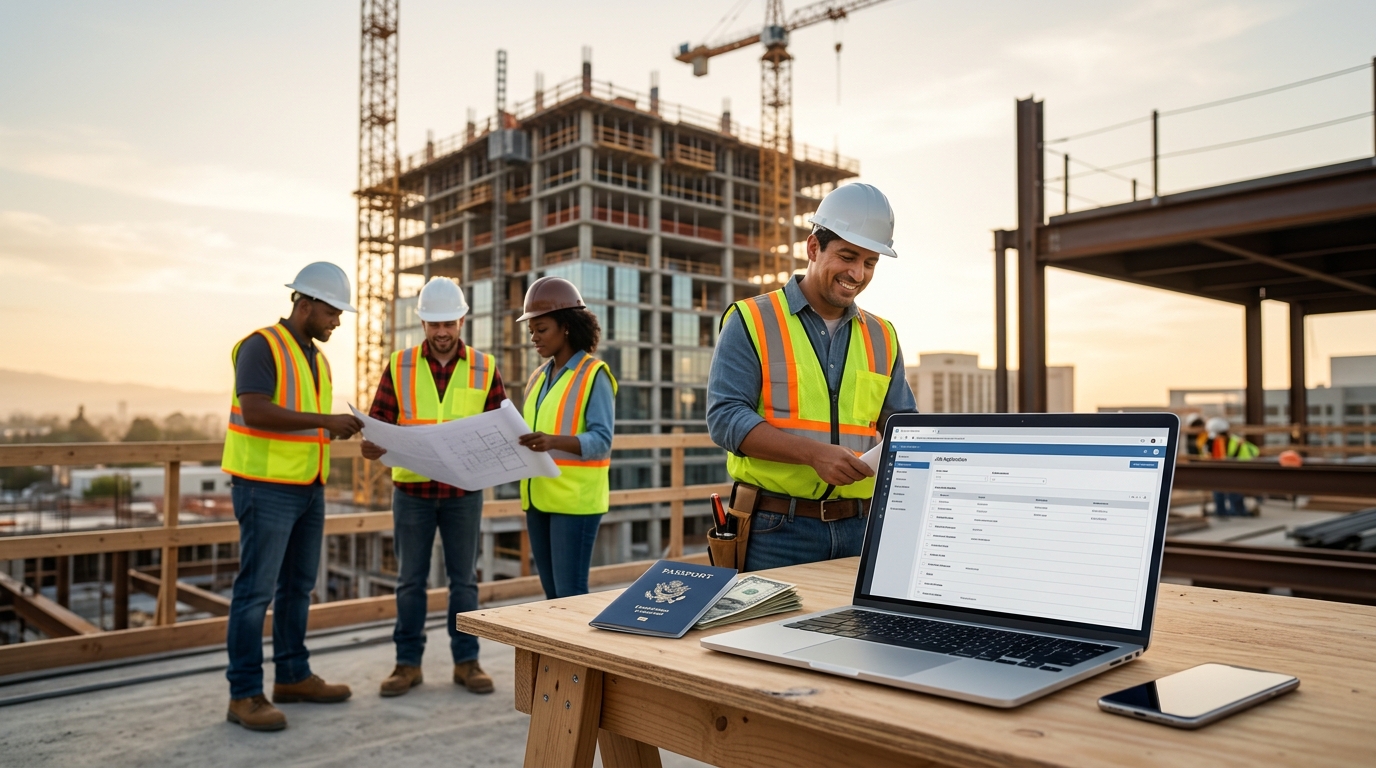
The United States construction industry is short on workers — and the gap is getting wider. According to the Associated Builders and Contractors, the industry needs an additional 500,000 workers in 2025 beyond its normal hiring pace to meet current project demand. Infrastructure expansion, industrial data center construction, and a sustained housing shortage are driving this demand across every trade category.
For skilled foreign workers, this shortage creates a direct path into the US labor market. American construction employers — from national contractors to regional builders — are actively sponsoring foreign workers through EB-3 Permanent Residency and H-2B Seasonal Visa programs to fill positions they cannot staff domestically.
This guide covers exactly what you need to know: which roles are being sponsored, what each visa costs and how long it takes, what employers pay by state and experience level, and the step-by-step process for securing a sponsored construction job in the United States.
The US Construction Worker Shortage: Why Employers Are Hiring Internationally
Understanding why employers sponsor foreign workers helps you position yourself as a candidate. This is not charity — it is a business necessity driven by hard labor market data.
The US construction workforce is aging rapidly. The Bureau of Labor Statistics reported in 2024 that the median age of construction workers in the United States is 43, and retirement outflows are accelerating faster than domestic training programs can replace them. At the same time, construction spending hit a record $2.1 trillion in 2024, according to the US Census Bureau, creating project backlogs that companies cannot fulfill with available local labor.
The result is a labor market where employers cannot afford to be selective about geography. Companies like Bechtel, AECOM, Fluor Corporation, Turner Construction, and Kiewit are actively recruiting internationally — not as a last resort, but as a core workforce strategy.
“The construction industry faces a structural labor deficit that will persist for at least a decade. International recruitment through established visa pathways is one of the most legally sound and operationally effective solutions available to employers.” — Ken Simonson, Chief Economist, Associated General Contractors of America
Which Construction Roles Qualify for Visa Sponsorship
US immigration authorities recognize the following construction roles as eligible for employer sponsorship:
- Civil and structural engineers
- Electricians and master electricians
- Plumbers and pipefitters
- Welders and ironworkers
- Heavy equipment operators (Caterpillar, Komatsu, Liebherr)
- Construction project managers and site managers
- General laborers and construction assistants
Roles tied to large-scale infrastructure — highway systems, energy facilities, industrial data centers, and commercial real estate — attract the most sponsorship activity because project timelines are long and labor commitments are multi-year.
EB-3 vs H-2B Visa: Cost, Timeline, and Which One Leads to a Green Card
Choosing the right visa is the most consequential decision in this process. The two primary pathways for foreign construction workers are structurally different — one is temporary, the other leads to permanent residency.
EB-3 Visa — Permanent Employment Green Card
The EB-3 is an employment-based immigrant visa. It leads directly to permanent residency in the United States — a green card — rather than temporary work authorization. For construction workers with a long-term job offer from a US employer, this is the most valuable option.
The process works as follows. Your employer files a PERM Labor Certification application with the US Department of Labor, proving no qualified American worker is available for the role. Once approved, the employer files an I-140 immigrant petition with USCIS. When your priority date becomes current — which varies by country of birth — you apply for your immigrant visa at the US Embassy in your home country.
Total employer cost for EB-3 sponsorship typically ranges from $5,000 to $15,000 in legal and filing fees. Processing time from PERM filing to visa approval runs 18 months to 3 years depending on your country of origin and current USCIS backlogs.USCIS EB-3 visa requirements and process → https://www.uscis.gov/working-in-the-united-states/permanent-workers/employment-based-immigration-third-preference-eb-3
H-2B Visa — Temporary Seasonal Worker
The H-2B is a non-immigrant visa for temporary, non-agricultural work. Construction employers use it for project-based hiring — a road expansion, a resort development, a data center build — where labor is needed for a defined period.
The visa is valid for up to one year and can be extended in increments. It does not lead directly to permanent residency, but US work experience gained on an H-2B significantly strengthens a future EB-3 application. The H-2B program has an annual congressional cap of 66,000 visas, split between two semi-annual periods. Demand regularly exceeds supply, so timing your application is important.
Additional Visa Options
The TN Visa applies to Canadian and Mexican citizens working under the USMCA agreement. It is valid for three years, renewable, and requires no separate USCIS petition — making it faster and simpler than the EB-3 for eligible applicants. Specialized construction professionals from Canada and Mexico qualify without the labor certification requirement.
The L-1 Visa applies to employees of multinational construction firms transferring to a US office. Companies like AECOM and Skanska, which operate globally, use this pathway to move project managers and senior engineers between countries.
| Visa | Best For | Duration | Leads to Green Card | Employer Cost |
|---|---|---|---|---|
| EB-3 | Skilled trades / permanent roles | Permanent | Yes | $5,000–$15,000 |
| H-2B | Seasonal / project-based labor | 1 year | No | $1,500–$4,000 |
| TN | Canadian / Mexican professionals | 3 years (renewable) | No | Minimal |
| L-1 | Multinational company transfers | 1–3 years | Possible | $3,000–$8,000 |
Qualifications and Eligibility Requirements for Foreign Construction Workers
US employers sponsoring visas are investing significant legal and financial resources in each hire. They screen candidates carefully. Meeting every requirement before you apply gives you a strong advantage.
Certifications That Increase Sponsorship Eligibility
- OSHA 10 or OSHA 30 Certification: Safety training is mandatory on most US construction sites. Having either certification before you apply signals job readiness to US employers.
- NCCER Certification: The National Center for Construction Education and Research credential verifies competency in specialized trades including welding, pipefitting, and electrical work. It is widely recognized by US contractors.
- Trade Licenses: Electricians and plumbers need state-issued licenses in most US states. Requirements vary — California, Texas, and New York each have their own licensing boards.
- PE License (Engineers): Civil engineers need a Professional Engineer license to stamp drawings and lead projects in the US. Foreign engineering degrees require evaluation through NCEES before a PE application is possible.
- Heavy Equipment Certifications: Operator certifications for Caterpillar, Komatsu, or Liebherr machinery significantly improve sponsorship prospects for equipment operator roles.
Experience Requirements by Role Level
Entry-level (1–2 years experience): General labor, construction assistants, and apprentice roles. Department of Labor prevailing wage: $30,000–$45,000 annually.
Skilled trades (3–5 years experience): Electricians, plumbers, welders, HVAC technicians. Department of Labor prevailing wage: $45,000–$70,000 annually. These roles attract the most H-2B and EB-3 sponsorship activity.
Senior roles (5+ years with project leadership): Site managers, project managers, civil engineers. Department of Labor prevailing wage: $70,000–$100,000+ annually. These positions qualify for both EB-3 and H-1B sponsorship in some cases.
Additional Requirements
English proficiency sufficient for site communication is required across all roles. Most visa categories do not mandate a formal test for construction workers, but employers conduct their own assessments during interviews. Physical fitness documentation, a clean criminal background check, valid passport, and vaccination records are standard pre-hire requirements across all sponsoring employers.
What Construction Workers Earn in the US — Salaries by State and Trade in 2026
Salary is one of the strongest arguments for pursuing sponsored construction work in the United States. The Bureau of Labor Statistics reported the median annual wage for construction and extraction occupations at $54,210 in 2024 — well above median wages in most countries where US employers actively recruit.
Salary by Trade (2026 Estimates)
| Trade | Entry-Level Annual | Experienced Annual | Top 10% Annual |
|---|---|---|---|
| Electrician | $42,000 | $65,000 | $98,000+ |
| Plumber | $40,000 | $62,000 | $95,000+ |
| Welder | $36,000 | $55,000 | $78,000+ |
| Civil Engineer | $65,000 | $92,000 | $130,000+ |
| Project Manager | $70,000 | $105,000 | $145,000+ |
| Equipment Operator | $38,000 | $58,000 | $82,000+ |
Highest-Paying States for Construction Workers
California leads nationally with a median construction wage of $72,000 annually, driven by union density, high cost of living, and aggressive infrastructure spending. The state’s prevailing wage laws push entry-level pay significantly above national averages.
New York pays a median of $68,000, concentrated in New York City where union electricians and plumbers regularly earn $95,000–$120,000 with overtime.
Washington and Massachusetts both average $63,000–$67,000, driven by technology infrastructure construction and dense commercial development.
Texas and Florida offer lower median wages — $48,000–$55,000 — but significantly lower cost of living and no state income tax, making take-home pay competitive with higher-wage states.
[EXTERNAL LINK: Bureau of Labor Statistics construction wages by state → https://www.bls.gov/oes/current/oes_nat.htm]
Most sponsoring employers add sign-on bonuses ranging from $2,000 to $8,000 for hard-to-fill trades, relocation assistance, health insurance, and 401(k) matching — benefits that significantly increase total compensation above the base salary.
How to Find and Apply for Sponsored Construction Jobs in the US
Step 1 — Identify sponsoring employers.
Search Indeed, LinkedIn, Glassdoor, and Jooble using terms like “construction jobs USA EB-3 sponsorship” or “H-2B construction visa sponsor.” Apply directly to career pages of major contractors: Bechtel, Fluor Corporation, Kiewit, Turner Construction, and Skanska USA all run active international recruitment programs.
Step 2 — Verify sponsorship before applying.
Read job descriptions carefully. Look for explicit mention of H-2B or EB-3 sponsorship. If the listing is unclear, contact the recruiter directly and ask before investing time in an application.
Step 3 — Build a US-targeted resume.
Your resume must document your trade in US-standard terms, list certifications by full name (OSHA 30, NCCER Level 2, etc.), quantify your experience (projects completed, team size managed, equipment operated), and include verifiable references from prior employers. Keep it to two pages maximum.
Step 4 — Interview prepared.
International candidate interviews are conducted via video call. Prepare to discuss specific projects you have worked on, your experience with US safety standards, and your timeline for relocation. Ask directly about the visa type, the employer’s legal counsel, and the expected timeline from offer to start date.
Step 5 — Secure your job offer and initiate the visa process.
Once an employer selects you, they issue a formal offer letter. This triggers the PERM labor certification process for EB-3 or the H-2B petition filing. Gather your documents in parallel: valid passport, trade certifications, employment history records, health clearance, and police certificate from your home country. USCIS H-2B temporary worker visa requirements → https://www.uscis.gov/working-in-the-united-states/temporary-workers/h-2b-temporary-non-agricultural-workers
FAQ: Construction Jobs in the USA With Visa Sponsorship
How much does it cost an employer to sponsor a construction worker on an EB-3 visa?
EB-3 sponsorship typically costs an employer between $5,000 and $15,000 in legal fees, USCIS filing fees, and Department of Labor labor certification costs. Employers who use immigration law firms pay at the higher end. Some large contractors absorb the full cost; others split certain fees with the employee, though DOL rules prohibit charging workers for labor certification costs.
Which US states offer the highest construction salaries for visa-sponsored workers in 2025?
California, New York, Washington, and Massachusetts consistently pay the highest construction wages, with median salaries ranging from $63,000 to $72,000 annually. Union states generally pay significantly more than non-union states. However, Texas and Florida offer competitive take-home pay due to lower cost of living and no state income tax.
What is the difference between an H-2B and EB-3 visa for construction workers?
The H-2B is a temporary work visa valid for up to one year, used for seasonal or project-based construction roles. It does not lead to permanent residency. The EB-3 is an immigrant visa that leads directly to a US green card and permanent residency. Construction workers with long-term job offers from US employers should pursue EB-3 sponsorship where possible.
How long does EB-3 visa sponsorship take for construction workers?
The full EB-3 process — from PERM labor certification filing to visa approval — takes between 18 months and 3 years, depending on the applicant’s country of birth and current USCIS processing backlogs. Workers from countries with high immigration volume, such as India and Mexico, face longer waits due to per-country visa quota limits.
Do construction workers on US work visas qualify for health insurance and workers compensation?
Yes. US labor law requires employers to provide workers compensation coverage to all employees regardless of immigration status. Most construction employers also include health insurance — medical, dental, and vision — in their benefits packages for full-time sponsored workers. These benefits are legally required at minimum under state workers compensation statutes.
Can a general laborer with no trade certification get visa sponsorship for US construction work?
Yes, through the H-2B visa for seasonal or project-based roles, or through the EB-3 unskilled worker category. However, competition is significantly higher for general labor positions. Obtaining OSHA 10 certification and basic equipment operator training before applying increases your chances and your starting wage considerably.
Conclusion
The US construction industry’s worker shortage is not slowing down. With $2.1 trillion in annual construction spending and a deficit of 500,000 workers in 2025, employers are not waiting for the domestic labor market to catch up. They are actively sponsoring foreign workers — and the legal pathways to make it happen are well established.
For skilled foreign tradespeople, engineers, and laborers, this is one of the most accessible routes into legal US employment available today. The EB-3 visa leads to permanent residency. The H-2B gets you on the ground and earning quickly. Both open doors that stay open.
The workers who succeed in this process share three things: documented, verifiable trade experience; the right certifications for their target role; and a disciplined, research-driven approach to finding sponsoring employers.
Start with your certifications. Build a resume that speaks directly to US employers. Target companies running active international recruitment programs. Apply to states where your trade pays the most and demand is highest.
The opportunity is real. The process is demanding but navigable. Foreign construction workers are building careers — and futures — in the United States right now. With the right preparation, you can too.