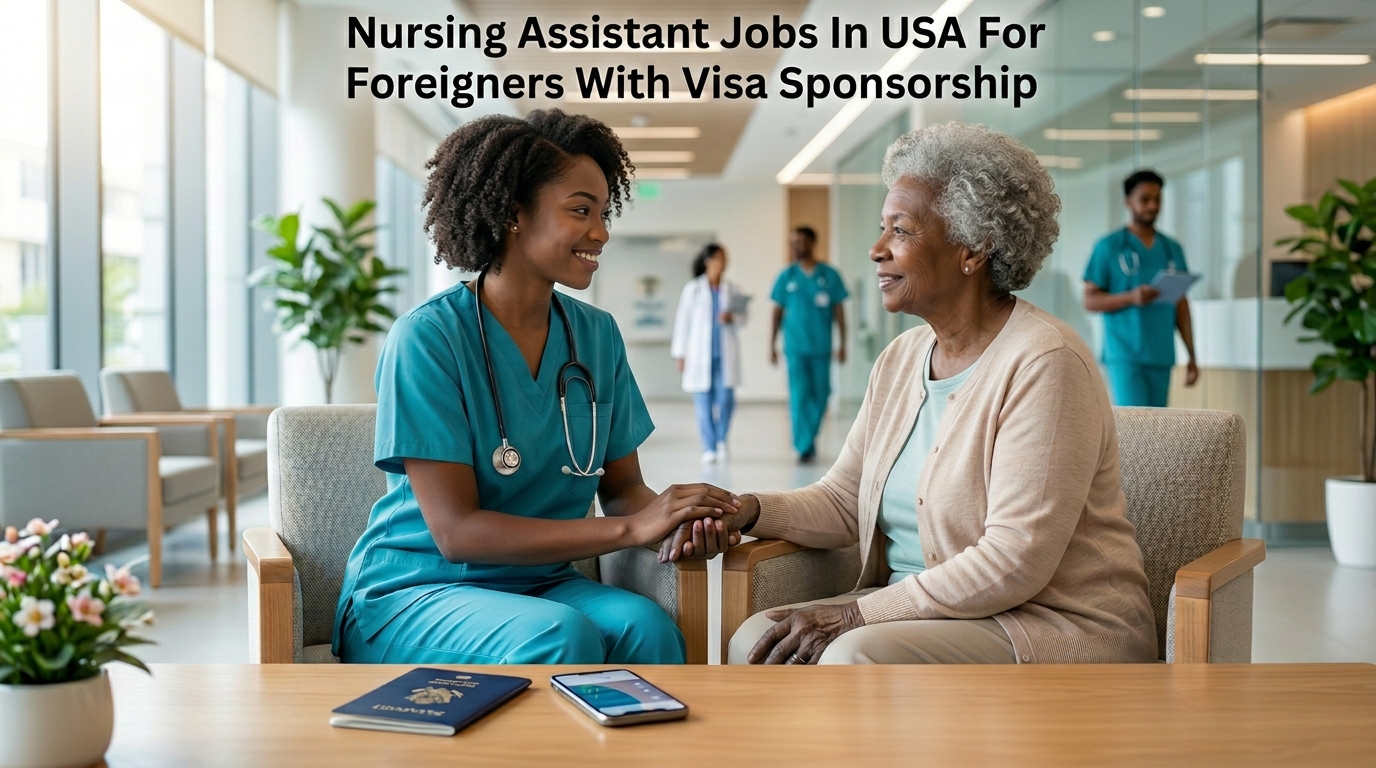
The United States continues to face a shortage of frontline healthcare workers. Nursing assistants, also known as Certified Nursing Assistants (CNAs) or Patient Care Technicians (PCTs), are among the most in-demand roles in hospitals, nursing homes, and assisted living centers.
For foreign healthcare workers, nursing assistant jobs in USA with visa sponsorship offer a practical immigration pathway. Many employers sponsor workers under employment-based visas such as the EB-3 green card. Salaries range from $30,000 to over $55,000 per year depending on experience and location. Some employers also offer relocation support and health benefits.
According to the U.S. Bureau of Labor Statistics, employment of nursing assistants is projected to grow steadily through 2032, driven by an aging population. In 2024 and 2025, healthcare workforce shortages remained a national concern, especially in long-term care facilities.
This guide explains job demand trends, visa options, salary expectations, employer sponsorship programs, eligibility requirements, and the step-by-step overseas application process.
What the US Healthcare Worker Shortage Means for Foreign Applicants
The demand for nursing assistants in the United States is not a temporary trend. The US Bureau of Labor Statistics projects that nursing assistant employment will grow 4% through 2032, with more than 210,000 job openings expected each year — driven primarily by an aging population and high turnover in long-term care settings. BLS Occupational Outlook for Nursing Assistants → https://www.bls.gov/ooh/healthcare/nursing-assistants.htm]
According to a 2024 report by the American Health Care Association, nearly 94% of nursing homes reported difficulty hiring CNAs, with more than half citing the shortage as a serious operational problem. This gap is why many healthcare systems have turned to international recruitment and visa sponsorship programs as a core hiring strategy.
For foreign applicants, this shortage translates to genuine leverage. Employers who sponsor visas are not doing it as a favor — they need workers they cannot find domestically, and they are prepared to invest in the immigration process to get them.
“The long-term care sector faces a workforce crisis that domestic supply alone cannot solve. International recruitment, when done ethically and with proper support systems, is one of the most viable solutions available.” — Dr. David Grabowski, Professor of Health Care Policy, Harvard Medical School
What a Certified Nursing Assistant Does Day to Day
Understanding the role is important before applying. Employers want candidates who know exactly what the job demands — and immigration officers assessing visa petitions look for documented experience in these specific duties.
A CNA or PCT in a US healthcare facility typically handles the following:
- Assisting patients with bathing, dressing, eating, and mobility
- Recording and reporting vital signs including blood pressure, temperature, and heart rate
- Helping patients move safely — from beds to wheelchairs, or between rooms
- Monitoring patient condition and reporting changes to the supervising nurse
- Supporting nurses during basic medical procedures
- Maintaining patient hygiene and room cleanliness
- Providing emotional support and maintaining patient dignity
The work is physically demanding and emotionally taxing. Candidates who have experience in hospitals, nursing homes, or home care settings and can document that experience clearly will have a stronger application — both with employers and in the visa process.
Skills Employers Prioritize
Beyond certification, US employers look for specific qualities in foreign CNA applicants:
- English language proficiency sufficient for patient communication and medical documentation
- Physical stamina for lifting and extended shifts
- Familiarity with electronic health record (EHR) systems
- A clean criminal and professional background
- Demonstrated reliability in prior healthcare roles
Visa Options for Foreign Nursing Assistants
Navigating US immigration is the most complex part of this process. There is no single visa designed exclusively for nursing assistants — but several visa categories apply, depending on your situation and the employer’s willingness to sponsor.
EB-3 Visa (Employment-Based Green Card)
The EB-3 is the most valuable visa option for foreign nursing assistants. It leads directly to permanent residency — a green card — rather than temporary work authorization.
To qualify, you need a full-time job offer from a US employer willing to sponsor the petition. The employer must also obtain labor certification from the Department of Labor (DOL), demonstrating that no qualified US worker is available for the role. Processing times vary significantly by country of origin and can range from one to several years, but the outcome — permanent residence — makes it the preferred path for many international CNAs.
Large healthcare systems like HCA Healthcare and Ascension Health actively use EB-3 sponsorship to recruit CNAs internationally, particularly for long-term care and skilled nursing facility roles.
H-2B Visa (Temporary Non-Agricultural Worker)
The H-2B visa allows US employers to bring foreign workers for temporary positions lasting up to one year, with possible extensions. Some healthcare facilities — particularly those with seasonal demand spikes or short-term staffing gaps — use this visa category for nursing assistants.
This visa does not lead directly to permanent residency, but it gives you US work experience, which strengthens future EB-3 applications. Availability is subject to annual caps set by Congress, so timing matters.
TN Visa (USMCA Professionals)
Citizens of Canada and Mexico can work in the United States under the TN visa through the United States-Mexico-Canada Agreement (USMCA). The visa is valid for up to three years and is renewable. It requires a job offer from a US employer but does not require a separate petition to USCIS — making it faster and simpler than the EB-3 for eligible applicants.
J-1 Visa (Exchange Visitor Program)
The J-1 visa allows foreign nationals to participate in structured exchange programs in the US, including health training programs. It is typically used for internships or short-term training rather than full employment. Some international healthcare staffing agencies use the J-1 pathway as an entry point for foreign CNAs looking to gain US clinical experience.
| Visa | Best For | Duration | Leads to Green Card |
|---|---|---|---|
| EB-3 | Long-term employment / hospitals / nursing homes | Permanent | Yes |
| H-2B | Temporary / seasonal healthcare roles | 1 year | No |
| TN | Canadian and Mexican professionals | 3 years (renewable) | No |
| J-1 | Training programs / clinical exchange | Program length | No |
Requirements You Must Meet Before Applying
US employers and immigration authorities have clear requirements for foreign CNA applicants. Meeting all of them before you apply increases your chances significantly.
- Education and Certification: The minimum educational requirement is a high school diploma or GED equivalent. Beyond that, you must complete a state-approved CNA training program. In the US, certification is administered through the National Nurse Aide Assessment Program (NNAAP) or an equivalent state examination. Requirements vary by state — California, New York, and Texas each have their own nursing board standards. Research the requirements in the state where you intend to work before applying. Additional certifications that strengthen your application include Basic Life Support (BLS), CPR certification, and HIPAA compliance training.
- English Language Proficiency: Most visa categories and nearly all US employers require functional English. For the EB-3 specifically, you may need to demonstrate English proficiency through a standardized test such as the TOEFL or IELTS. Patient care requires clear communication — employers take this seriously.
- Work Experience: Entry-level positions exist, but employers sponsoring visas — who are investing significant time and money in your application — generally prefer candidates with at least six to twelve months of documented clinical experience. Experience in hospitals, nursing homes, assisted living facilities, or home care settings is most relevant.
- Background and Health Clearances: Expect a criminal background check, drug screening, and professional reference verification. Healthcare organizations also require proof of vaccination — typically including COVID-19, tuberculosis (TB) test results, and a general health examination — before you begin work.
What Nursing Assistants Earn in the United States
Salary is one of the strongest arguments for pursuing CNA work in the US. Pay varies by state, experience level, and facility type — but even entry-level wages compare favorably with healthcare pay in many other countries.
According to the Bureau of Labor Statistics, the median annual wage for nursing assistants in the United States was $38,200 in 2024, with hourly wages ranging from $14.56 to $28.15 depending on location and experience.
Salary by Experience Level
- Entry-level (0–2 years): approximately $14.44/hour ($28,000–$34,000 annually)
- Mid-level (3–5 years): approximately $18.36/hour ($35,000–$45,000 annually)
- Experienced (6+ years): approximately $21.41/hour ($46,000–$55,000 annually)
Highest-Paying States for CNAs
| State | Average CNA Salary | Key Driver |
|---|---|---|
| California | $45,000–$55,000 | High cost of living, strong union presence |
| New York | $40,000–$50,000 | Dense hospital network, urban premium |
| Hawaii | $42,000–$48,000 | Geographic isolation, limited local supply |
| Texas | $32,000–$42,000 | Rapid population growth, new facility demand |
| Florida | $30,000–$40,000 | Large retiree population, high long-term care need |
High-paying states also have higher living costs. California and New York offer the best wages but require more to live comfortably. States like Texas and Florida offer a lower cost of living alongside solid salary growth potential.
Most sponsoring employers also offer sign-on bonuses, relocation assistance, health insurance, paid time off, and tuition support for career advancement — benefits that significantly increase total compensation.
Employers That Sponsor Visas for Foreign Nursing Assistants
Finding an employer willing to sponsor your visa is the most important step in this process. These are established healthcare organizations with active international recruitment programs.
HCA Healthcare operates more than 180 hospitals and 2,000 care sites across 21 states. It is one of the most active EB-3 sponsors for CNAs in the country, with concentrations in Texas, Florida, Tennessee, and California. Visit HCA Healthcare Careers to search current openings.
Mayo Clinic operates in Minnesota, Arizona, and Florida. It recruits internationally for qualified healthcare professionals and offers comprehensive benefits including tuition assistance. Check Mayo Clinic Careers for CNA positions.
Cleveland Clinic has facilities in Ohio, Florida, and Nevada. It runs international recruitment campaigns and offers visa sponsorship for skilled healthcare workers. Visit Cleveland Clinic Careers for openings.
Ascension Health operates more than 2,600 healthcare locations nationwide. As a nonprofit, it recruits CNAs internationally on a regular basis and offers strong professional development support. See Ascension Careers for available roles.
Genesis Healthcare runs more than 250 skilled nursing facilities across multiple states, making it one of the largest long-term care employers in the country. Genesis actively sponsors CNAs due to consistent demand in aging care. Visit Genesis Healthcare Careers for listings. National Association of Health Care Assistants → https://www.nahcacares.org]
Staffing agencies specializing in international healthcare placement — including WorldWide HealthStaff Solutions (WWHS), InterStaff, and Conexus MedStaff — also connect foreign CNAs with sponsoring employers and often manage portions of the immigration process on your behalf.
How to Apply for Nursing Assistant Jobs In USA For Foreigners With Visa Sponsorship
Step 1: Get certified. Ensure your CNA certification or equivalent is documented and, where possible, evaluated for US equivalency. Research the requirements in your target state.
Step 2: Build your resume. Your resume must include a professional summary, documented clinical experience, certifications, and references from prior employers. Keep it clean and factual — no filler.
Step 3: Search for sponsoring employers. Use job boards including Indeed, LinkedIn, Glassdoor, and specialized platforms like H2B Visa Jobs. Search “CNA visa sponsorship” or “nursing assistant EB-3 sponsor.” Apply directly to employer career pages as well.
Step 4: Apply and interview. Interviews for international candidates are typically conducted via video call. Prepare to discuss your clinical experience, English proficiency, and willingness to relocate. Ask the employer directly about their visa sponsorship process and timeline.
Step 5: Secure a job offer. Once an employer selects you, they issue a formal offer of employment. This document is the foundation of your visa petition.
Step 6: Visa petition. Your employer files a petition with USCIS and, for EB-3, obtains labor certification from the Department of Labor. Once approved, you apply for the visa at the US Embassy or Consulate in your home country.
USCIS how to apply for an employment-based immigrant visa → https://www.uscis.gov/green-card/green-card-processes-and-procedures]
FAQ: Nursing Assistant Jobs in the USA With Visa Sponsorship
Can a foreign national work as a nursing assistant in the US without prior US experience?
Yes, but it is harder to find a sponsoring employer without any clinical experience. Most employers investing in visa sponsorship prefer candidates with at least six months of documented healthcare work. Volunteering at hospitals or clinics in your home country and getting that experience verified in writing helps.
How long does EB-3 visa sponsorship take for CNAs?
Processing time varies by country of origin and current USCIS backlogs. For applicants from countries without high immigration volume, the process can take one to two years from petition to visa approval. For applicants from high-demand countries like India or the Philippines, waits can be longer due to visa quota limits.
Do I need to pass a US certification exam before applying?
You do not need to pass a US CNA exam before applying, but you will need to pass it before practicing in most states. Many sponsoring employers allow candidates to complete the exam after arriving in the US, especially under EB-3 or H-2B programs.
Which states have the most CNA jobs with visa sponsorship?
California, Texas, Florida, New York, and Ohio consistently have the highest volume of CNA job listings, including sponsored positions. These states also have large healthcare networks more likely to run international recruitment programs.
What documents do I need for the visa application?
You typically need a valid passport, a formal job offer letter from your US employer, proof of CNA certification or equivalent, English language test results (if required), health clearance documentation, and a clean criminal background check.
Can a nursing assistant get a green card through employer sponsorship?
Yes. The EB-3 visa leads directly to permanent residency. Once your employer’s labor certification and USCIS petition are approved and your priority date becomes current, you receive a green card allowing you to live and work permanently in the United States.
Conclusion
Nursing assistant jobs in USA with visa sponsorship remain a strong immigration pathway in 2026. Demand continues due to workforce shortages and an aging population. Salaries are competitive and permanent residency is possible under the EB-3 visa.
Foreign applicants who meet certification standards, secure employer sponsorship, and complete immigration steps can build a stable healthcare career in the United States.